The Hidden Cost of Fragmented Operational Information
How fragmented operational data turns delays into financial exposure.
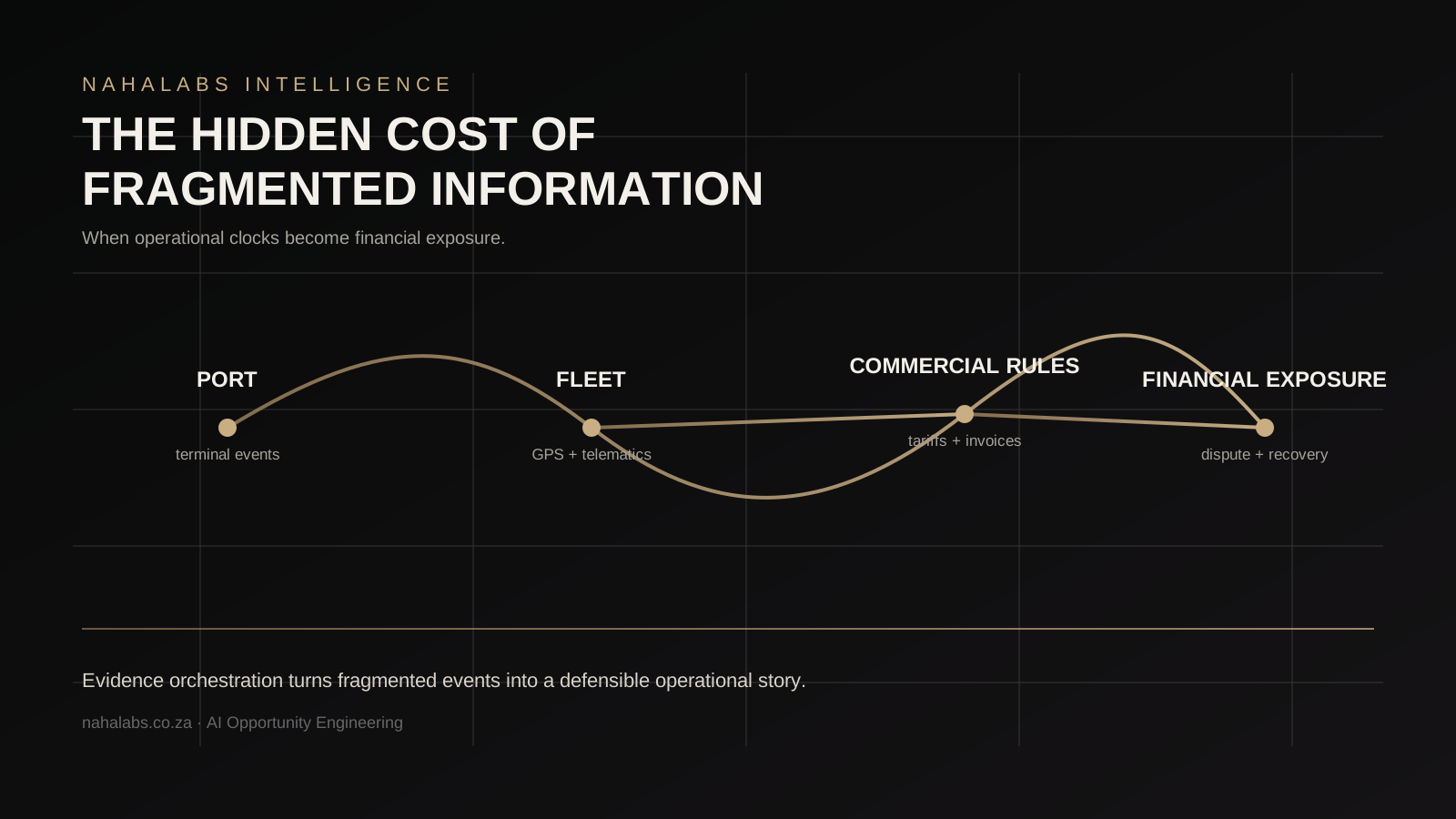
A delayed truck is visible.
A delayed vessel is visible.
A container sitting in a terminal is visible.
What is much harder to see is the chain of evidence connecting those events to the invoice that eventually arrives weeks later.
That is where an expensive operational problem begins.
Across South Africa's freight and logistics environment, important information can be distributed across fleet telematics, terminal systems, vessel data, invoices, tariff schedules, email, messaging platforms, spreadsheets and customer portals.
Each system may contain a legitimate piece of the truth.
The problem is that the business often has no unified way to reconstruct the whole event.
That matters because logistics costs are frequently time-dependent.
A few hours can become another day of detention. A missed free-time window can become demurrage. A terminal disruption can create standing time, storage exposure or downstream customer disruption.
And once the invoice arrives, the question is no longer simply:
What did we get charged?
It becomes:
What actually happened, when did it happen, which evidence proves it, and which part of the charge is supported by the underlying events?
Durban provides a useful real-world example
In August 2026, Durban Gateway Terminal went through a major transition to the NAVIS N4 terminal operating system.
Following the transition, the South African Freight and Logistics Association and the Road Freight Association reported that weekly container throughput declined by 26%, while reported terminal waiting times reached eight to twelve days. Industry reporting also cited average July vessel anchorage and berth delays of about 80 and 106 hours respectively.
These are source-reported industry figures, not independent NahaLabs measurements.
The consequences were not limited to vessels. Industry reporting also described severe landside pressure and reefer congestion at Durban Gateway Terminal.
A separate regulatory matter illustrates the commercial tension created by such conditions. Positive Freight Solutions' Container Division, representing 140 transporters and about 6,000 workers, filed a complaint with the Competition Commission concerning Durban Gateway Terminal, Transnet and eight shipping lines. The matter was subject to preliminary assessment; the complaint is an allegation, not a finding of unlawful conduct.
The important point is not which party is ultimately responsible.
It is that a disruption creates a multi-party evidence problem.
The clock does not exist in one place
Consider a simplified container journey.
The vessel is discharged.
The container becomes available.
A truck is dispatched.
The truck enters a staging area.
The truck waits.
A terminal transaction eventually occurs.
The container leaves the terminal.
Later, an invoice arrives.
Every one of those events may exist somewhere.
But they may exist in different systems.
The vessel event could be in an AIS data feed.
The truck movement could be in a telematics platform.
The terminal transaction could sit inside a terminal operating system or appear on a receipt.
The commercial rule could exist in a carrier tariff PDF.
The invoice could arrive by email.
The explanation for the delay could be sitting in a WhatsApp conversation.
The result is a fragmented operational record.
And fragmented records create an uncomfortable question:
Which clock should the business trust?
That is particularly important because demurrage and detention are explicitly time-based commercial mechanisms.
Maersk's published South African import demurrage and detention revision, effective 15 April 2026, lists three days of import demurrage free time for standard dry containers at Durban's Pier 1, Pier 2 and Point. The same published schedule lists R2,698 per day on Day 4 and R4,391 per day from Day 5 for a 20-foot dry container.
These are Maersk-specific published tariff terms, not universal South African carrier tariffs.
Source: Maersk South Africa Import Demurrage & Detention Revision
The commercial lesson is simple:
Time is not just an operational metric. It is a financial variable.
South Africa's ports already recognise the cost of operational performance
This is not only an argument made by logistics companies.
The Ports Regulator of South Africa's 2026/27 Record of Decision approved an overall weighted average tariff increase of 7.57%. It also recorded a R247 million Weighted Efficiency Gains from Operations adjustment in favour of port users following a weighted efficiency loss.
Source: Ports Regulator 2026/27 Record of Decision
That does not prove that every demurrage or storage charge is invalid.
It demonstrates something more fundamental:
Operational performance has measurable economic consequences.
Once time affects money, reliable event evidence becomes commercially important.
The problem is not a lack of software
Most large logistics organisations already have substantial software.
- a TMS for shipment execution;
- ERP and finance systems for invoices and payments;
- fleet telematics for vehicle movements;
- visibility platforms for shipment tracking;
- carrier portals for bookings and documents;
- terminal systems for container transactions.
The problem is that these systems were generally designed to perform their own jobs.
A fleet system knows where a truck was.
A terminal system knows what happened inside the terminal.
An invoice system knows what was billed.
A vessel-tracking system knows where a ship was.
A tariff document explains how a charge should be calculated.
But the commercial investigation requires something different.
It requires the systems to be viewed together.
The missing layer is evidence orchestration
Imagine that one container generates the following evidence:
Separately, the commercial system calculates a charge based on the applicable free-time rules.
The invoice does not necessarily contain the operational story.
The operational systems do not necessarily calculate the financial consequence.
And the finance team does not necessarily have the time or tools to reconstruct the evidence chain manually for every disputed charge.
That is the gap.
The opportunity is not simply another dashboard.
It is an evidence layer that connects operational events, commercial rules and financial consequences.
What an intelligent system changes
The useful application of AI here is not to let a model decide who is legally liable.
It is to make fragmented information usable.
An intelligent system could ingest:
Operational evidence
GPS and telematics, terminal receipts, vessel movements, gate transactions and operational advisories.
Commercial evidence
Invoices, bills of lading, contracts, tariff schedules and free-time rules.
Contextual evidence
Weather events, port notices, equipment outages, customs status and other documented external events.
Unstructured communication
Emails, PDFs and authorised messaging records.
The system can then reconstruct a common event timeline.
It can identify conflicting timestamps.
It can identify missing evidence.
It can compare the reconstructed timeline with the applicable commercial rules.
And it can calculate the financial consequence using deterministic rules rather than asking an AI model to invent the number.
That distinction matters.
The goal is not automatic legal judgment
A credible enterprise system should not say:
“The terminal is legally responsible.”
That is a legal conclusion.
The system should instead say something closer to:
“The available evidence shows that the truck entered the staging area at 08:10, terminal access was recorded at 17:45, and the attached terminal advisory reports an operational interruption during the intervening period. The evidence currently supports a review of whether this period should be included in the charge calculation.”
That is more useful.
It is precise.
It is auditable.
It shows the source of the conclusion.
And it leaves the final commercial or legal decision with the appropriate human reviewer.
This is why fragmented information becomes expensive
The cost of fragmented information is not simply the cost of switching between applications.
Management blind spots. Leadership sees individual delays and individual invoices, but not the recurring pattern connecting them.
That last point is particularly important.
A single disputed invoice is a finance problem.
A recurring pattern of disputed invoices caused by the same operational condition is a systems problem.
What the intelligent-systems opportunity looks like
At NahaLabs, we call this AI Opportunity Engineering.
The question is not:
“Where can we add AI?”
The better question is:
“What important business problem becomes solvable when the right software, data and AI are combined into an intelligent system?”
For logistics, one answer is the ability to move from fragmented operational records to an evidence-backed financial investigation.
The bigger lesson
The Durban disruption illustrates a broader pattern that exists far beyond ports.
Businesses increasingly have large amounts of operational information.
What they often lack is a reliable way to connect that information into a coherent explanation of what happened and what it cost.
That is the hidden cost of fragmented operational information.
The information already exists.
The problem is that it exists in pieces.
The next generation of enterprise systems will increasingly be judged not by how much data they collect, but by whether they can turn fragmented evidence into trusted operational state, explainable decisions and measurable commercial outcomes.
That is the difference between adding AI to a workflow and engineering an intelligent system around a business problem.
Diagnosis → Prototype → Production
NahaLabs builds intelligent systems for business problems that are too specific for generic software and too important to manage manually.
In logistics, that can mean connecting operational evidence, commercial rules and financial outcomes into one controlled investigation workflow.
The objective is not more software.
It is better evidence, faster decisions and measurable recovery.
Evidence & claim discipline
FACT: Maersk's published South African tariff terms and the Ports Regulator's 2026/27 Record of Decision.
SOURCE-REPORTED CLAIM: Durban Gateway Terminal disruption figures reported by SAFLA/RFA and industry publications.
ANALYSIS: The interpretation that fragmented operational evidence creates an investigation and commercial-control gap.
INFERENCE: Connecting evidence sources can reduce the manual effort required to reconstruct operational events.
HYPOTHESIS: A production evidence-fusion system can materially improve recovery and dispute handling when validated against historical cases.